I've heard from several people that they would write for The Silverfish, if only they knew what to write. I'm not here to tell you what to write, exactly. It has to come from you, or you won't have fun writing it. And fun is the point...for the most point.
I do have a general list of what we're looking for.
Reviews of books, movies based on books
Article responses
Action reports from conferences: reactions to conferences attended; Review of conferences-what helped, what didn't.
Class reports: Kind of like a "what I know now that I didn't know..."; "I took this class, and it was good because..."
Opinion pieces on issues that have arisen in your research (e.g. Why we should give money to libraries after natural disasters).
More breaking news, things and issues that will change quickly, can be posted here, on the blog.
If you're still unsure about what to write, but might have ideas, you are always welcome to bounce them off of us. Just email them to thesilverfish@gmail.com
Happy Writing!
Monday, November 7, 2011
What's in a name?


Saturday, July 16, 2011
Con Seeks Pro: Electronic Books
This is something a little new for us. We hope to spark conversations about different aspects of our information world by setting up one side of an argument. I'll be taking the con side in this discussion as I am a book snob, and I welcome comments from anyone and everyone on this topic.
As I wrote, I am a book snob. This title encompasses everything from content to smell. For the sake of argument, we'll focus on the snobbery that has to do with what makes a book a book. For me, a book consists of several pages (several being anywhere between 4 and infinity), with words and, sometimes, pictures that tell a story. This story can be fictional or not, it doesn't matter. It is usually made of paper and held together by glue. Books come in many different shapes, sizes and lengths. A book has heft. You can hear the paper as you turn the page. There is a specific smell to a book, especially if the pages have begun to turn yellow. It's slightly musty and sweet. It's welcoming and relaxing. A book that is falling apart, while a sad sight, shows that it has been well loved. Also, nothing beats cracking the spine on a paper back. I am well aware that such an act is really bad for the binding, but if they are privately owned books: love it well.
Before I become too carried away in my musings, I have to admit that I do own a Nook Color from Barnes & Nobel, and I think it's a very handy device. I can search the web, check my email, and download the readings for class directly. It saves money and paper in this regard because I do not have to print out anything. I have even downloaded and read a few stories on my Nook. However, I would not call the stories I've downloaded books. They do not meet my above requirements, though they are novels. An e-book is not a book because, despite what can be done with e-readers--added sound effects, added heft, covers that make it seem like a book--it does not, above all else, smell like a book. There are ways to change that. One could spritz it with a certain perfume from CB I Hate Perfume (In The Library), but it's not the same. Electronic books are posers that really don't deserve to be called books because they fail to meet my requirements of what makes a book a book.
Saturday, March 19, 2011
The Silverfish Podcast #005 -- David Laskin and The Long Way Home
 The Cyberpunk Librarian sits down with the historian and biographer David Laskin. We talk about The early 20th century emigrant experience, the horrors of 'the war to end all wars' and the struggle for legitimacy by conscientious objectors during that war.
Also, weather.

This podcast is provided under a Creative Commons Attribution-ShareAlike 3.0 Unported License and is dedicated to the memory of Corporal Frank Buckles, the last member of the American Expeditionary Force.

Wednesday, March 16, 2011
'Fish Food
We realized that should the move to a fully virtual reading experience take place, the humble Lepisma saccharina, deprived of the glues and inks that give it sustenance, may in fact become extinct. As our slightly ironic mascot, we feel it to be our duty to provide a safe future habitat for this lovable (if disgusting and universally reviled) creature. We therefore take the following radical step:
The Silverfish Newsletter will be printing a supplemental issue of prose, poetry and black & white two dimensional art. As always we want this to be your publication, so we welcome your submissions!
Please send poetry, prose or image files to: thesilverfish@gmail.com prior to the submission deadline of May 1st 2011. We'll have broadsheets (11" by 17") ready in time for Summer!
(While your submissions cannot be returned, we promise that we will not feed them to any biological silverfish)
Tuesday, March 8, 2011
Silverfish Podcast #004 -- Dr. Janes vs Watson and The End Of Days

Karl and Dr. Janes discuss the implications of IBM's Jeopardy playing supercomputer. Will some clever assemblage of Big Data and Natural Language Processing spell the end of the Librarian as a profession? Find out here first!
All Music © 2001-2010 Kevin MacLeod
(http://incompetech.com/m/c/royalty-free/)
Sunday, January 9, 2011
Silverfish Podcast #002
This episode features an interview with Conor Casey, Labor Archivist for the University of Washington. Conor walks us through his personal and family involvement with labor as well as his interest in the greater context of labor's influence on Pacific Northwest Culture. His library guide-page can be found here. The Labor Archives of Washington State at: http://www.lib.washington.edu/specialcoll/laws/ is the long URL he mentioned at the end of the interview.


You can listen to this episode at:
Friday, January 7, 2011
All your blogs are belong to us (we hope)

The Silverfish's Blog Roll (http://students.washington.
Monday, December 20, 2010
The Silverfish has gone audio!

You can listen to our first podcast at:
The links to the collections and pages discussed in this podcast are available here:
The music library special collections:
http://guides.lib.washington.
The Offenbacher Mozart Collection
http://www.lib.washington.edu/
Audio Preservation:
http://guides.lib.washington.
Thursday, November 11, 2010
Library Book Blogs: The good the bad and the ugly

"Awful Library Books," one of my favorite blogs , has a new address and a new look. If you haven't seen this site, you should definitely check it out. It's a great reminder of the importance of weeding!
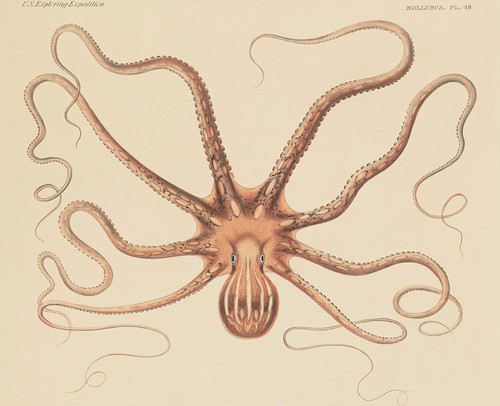
Afterward, you can cleanse your eyeballs by spending some time on my other favorite site, BibliOdyssey.
Tuesday, October 26, 2010
Inside Edition takes on the library
http://www.insideedition.com/
Thanks Lisa!
Sunday, June 28, 2009
Friday, May 29, 2009
More crazy furniture!

To follow up on an older post, here are some neat bookshelves I found.
#1 reminds me of the sleeping pods in 2001: A Space Odyssey
#6 is akin to the movable shelves VA Hospitals used to use to bring reading material to bed-ridden patients, only much nicer! (don't ask me how I know about these things, some things are best left unknown...)
#18 a round sofa-bookcase!! Chic!
Which are your favorites?
Thursday, April 30, 2009

Cat and librarians. Libraries and cats. Dewey the wonder cat. And now, and amazing interactive map of cats and libraries from around the world, both currently purring with us or chasing squirrels in the great Heaviside Layer.
(image by adamscarroll)
Monday, April 20, 2009
BEHOLD! The Power of the Archivist!

Diablo III has a new character, The Archivist. And it's about time librarian kick-assery was acknowledged by the video game industry. Now if I can just harness the shushing power, the library would be a much nicer place to work. But I wonder who will clean up the mess...
Tuesday, April 7, 2009
There's an encyclopedia for everything...
- Entertaining from Ancient Rome to the Superbowl: An Encyclopedia (KCLS owns it)
- Encyclopedia of Hair: A Cultural History (UW-Tacoma has a copy)
- The Business of Wine: An Encyclopedia
- Extinct Animals : An Encyclopedia of Species That Have Disappeared During Human History
- Prime-Time Religion: An Encyclopedia of Religious Broadcasting (Available now at Suzzallo!)
- For Appearance' Sake: The Historical Encyclopedia of Good Looks, Beauty, and Grooming (In the Suzzallo Reference section)
- Encyclopedia of Human-Animal Relationships: A Global Exploration of Our Connections with Animals (a four volume set!)
Friday, March 27, 2009
Lexicons in literature
So my question is, why would one include a lexicon in a book when crystal clear definitions for the terms have already been given? Stephenson's lexicon is interspersed throughout the story. Some are at chapter breaks and some right in the middle of a scene (for lack of a better word). I personally find this to be quite irritating. I am compelled to read the definitions because I am afraid that I will miss something vital to the story if I do not, and yet I rarely learn something that he has not already revealed through his diction. I would be tempted to see them included as footnotes - but know that I would still stop to read them in the same manner. For me, it would be best to put them at the end in a glossary that I could read if I wanted to, or if I had a question about the meaning of a term. With all that said, however, it is a really well-written book and has some interesting ideas for archivists and philosophers - as well as musicians, mathemeticians, scientists... Just read the book.
Another interesting question, or thought really, is also raised in my mind as I read this book. Has Stephenson created a new genre with his latest creation? This work is what he styles as speculative fiction, as opposed to science fiction. It definitely contains some science, and it is fiction - yet it is more than that. To hear what Stephenson himself has to say about this potentially emerging genre, click here.
Sunday, March 8, 2009
Book Talking
Anyway, one of the things we learned in the class was the importance of book talking in readers' advisory. I'm not all that comfortable with public speaking in general, and book talking is (in my opinion) even more difficult than "regular" public speaking (giving formal presentations and stuff like that) because you don't want to sound like you're giving a speech; the goal is to sound as natural as possible--as if you're just having a conversation with the audience.
During the class when we first began discussing book talks, Nancy gave us "17 things to think about"--useful hints and tips for doing book talks. Here they are (somewhat paraphrased):
- Before you start talking, take a deep breath and let it out. (Believe it or not, this is really important and it does help.)
- Smile. :)
- Do the book talk in a way you feel comfortable. There is no right or wrong "style" to give a book talk. The most important thing is to be yourself.
- Show enthusiasm! You are trying to "sell" the book to your audience. On a related note, don't book talk something you didn't really like or that you haven't read yet. The audience can tell you're faking it.
- Try to get to a point where you're not reading from your notes. Speak as naturally as possible; have a conversation with the audience. If you have notes, keep them short. Know how you're going to start and end the talk, but try not to have a script.
- Don't overprepare. If you try to memorize your entire book talk, you'll either sound fake or freak out if you lose your place.
- Maintain eye contact.
- Ignore the distractions in the audience (people texting, sleeping, etc.).
- When you're preparing your book talk, ask yourself what the "takeaway" of the book is. What do you want the audience to remember? Make sure there's at least one detail for them to grab onto. And don't put in minor or irrelevant details. You don't want your book talk to feel cluttered.
- Try to give the audience a sense of who you are and what you like to read.
- Use language that the audience would use. This goes back to being "conversational" in your book talks.
- Keep it short. Don't talk about the plot for more than 1 or 2 sentences. And don't give away plot twists or the exciting stuff.
- Try to convey what your own feelings were when you were reading the book. People like to hear about how you personally connected with the book.
- If you are good at reading aloud, incorporating a passage into your book talk is a good way to hook the audience. But if you're not good at it, or you're too nervous, just don't do it.
- Another way to do a hook is to start with a question. "Have you ever wondered . . . " Other good phrases: "Imagine . . . " or "If you like to read ____, here's another . . . "
- Don't make your closing line "I really loved this book." Find an unusual way of ending the talk that brings everything together.
- If you're book talking a lot of books at once, have a handout with a list of the books with space underneath each one for notes.
Sunday, February 15, 2009
Miscellaneous Info. Bits
Books! I just read Graceling by Kristin Cashore and Hunger Games by Suzanne Collins. These are both *fabulous* YA books, but rest assured that adults will enjoy them, too. Both will have full reviews coming in the next issue of SilverFish. Don't wait for those; read them now. As my 12 year old niece said "Graceling is better than Harry Potter, Twilight and Maximum Ride!" Can you get a better recommendation than that?
Diversity! I just took a great skills workshop class through the Evans School called "Authentic Conversations in Diversity." One of the things we discussed was the use of phrases or words that may unintentionally be offensive to someone. A few were obvious to me, such as "that's so gay" or "jew them down". One that was new to me was "rule of thumb." This is based on an old law that said a man could beat his wife with a stick - as long as it was no wider than his thumb.
Information Grounds! Sometimes I truly am an ostrich in regards to information. How can I be so oblivious to things happening around me? For example, I am doing a DFW at Garfield HS this quarter, which has been an amazing opportunity to work with teens, and I was talking to a friend who is doing his student teaching at a high school in Shoreline. He asked me how things have been at Garfield after the basketball game... Huh? Apparently there was a big racial incident at the game between them and Redmond. One of the sad things here for me is that I was at GHS 3 of 5 days after the incident and still never picked up on it. What kind of information professional am I? So, learn a lesson from me - by doing what I say and not what I do - keep your eyes and ears open no matter where you are because I'm sure there is some good information, just waiting to be discovered.
Good luck with registration for spring quarter! Remember that it is this Friday, Feb. 20th.
Monday, February 9, 2009
Book Furniture

Move over book arts!
Time now for some functional book creations. Check out these vases, lamps, and table-like things by artist Laura Cahill. She makes use of materials that would otherwise been wasted. Cahill states "the glue in old books make them extremely difficult to recycle. Aware of this I challenged myself to turn the second hand books that I had been collecting, into desirable objects such as furniture, lighting and ornaments.."
While some people believe the book to be a sacred object, I'd rather have a book be reincarnated into functional art than tossed nonchalantly into the recycle bin (yeah, big dumpsters in Allen, I mean you) or slowly decomposing in landfills. And this so much more chic than those BigCozyBooks blighting a library near you.
This is not a new idea. Indeed, in 2004 a MIT visiting scientist created an entire bedroom-themed recycled book display. While I'll pass sleeping in that bed (um, paper cuts anyone?) the rocking chair is pretty nice. If only I had a little extra time on my hands...

Sunday, February 1, 2009
Information Overload: Trying to Deal
Check it out.